












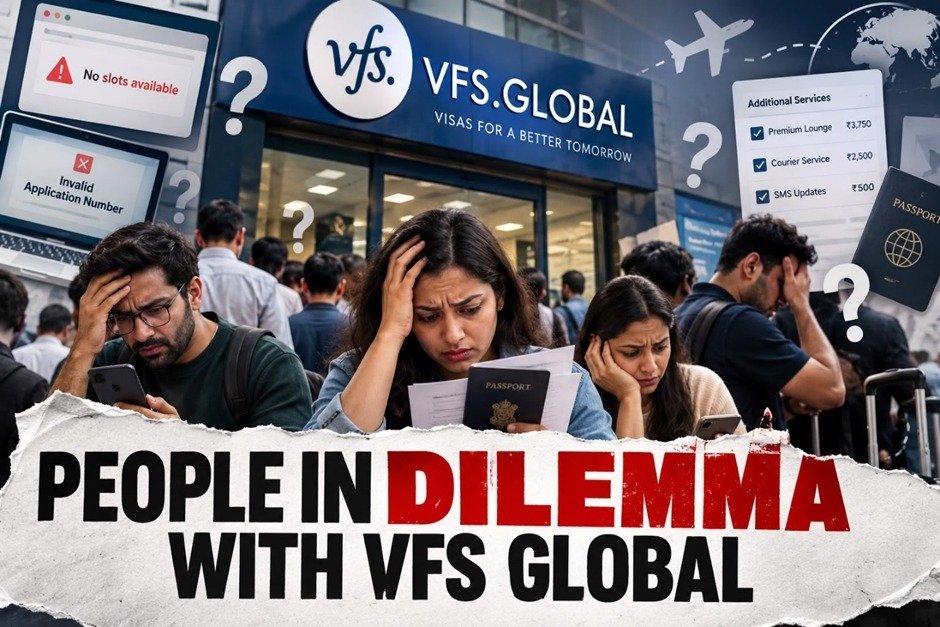
VFS Global’s expanding network is raising questions about whether its growth is translating into better services for visa applicants. The company reportedly added 517 centres in 2025 and a net 227 in the first half of 2026, taking its global network to 4,250 centres by June.
While expansion can improve geographical access, applicants continue to flag concerns about infrastructure, accessibility and customer service. Several centres are located far from city centres, with limited public transport connectivity and inadequate parking, making visits inconvenient.
In Mumbai, VFS Global acknowledged parking constraints and traffic congestion near its Mahalaxmi centre in January 2025. Centres in Kochi, including S&T Arcade and Coastal Chambers, have also faced concerns over parking shortages and congested approach roads.
Concerns have also emerged over waiting facilities. In Pune, an applicant in October 2026 raised questions about inadequate seating. VFS Global’s guidance for its Mumbai South centre states that dedicated outdoor waiting space may not be available and advises applicants against arriving more than 15 minutes before their appointments.
Similar complaints have surfaced internationally. In June 2026, a visitor to VFS Global’s Goswell Road centre in London reported waiting around 100 minutes for a 15-minute appointment, alleging that only six of 18 counters were staffed. The applicant also described overcrowding and a leaking ceiling. In Australia, another applicant reportedly faced a seven-hour wait and was moved repeatedly between counters.
For students, however, visa processing delays can have consequences far more serious than inconvenience. Across social media platforms, students and prospective international scholars have voiced anxiety over alleged service failures, appointment difficulties, processing delays and inadequate support. For those preparing to study abroad, a visa is not merely a travel document; it is the gateway to an academic opportunity that may have taken years of preparation and substantial financial investment to secure.
When visa-related processes go wrong, students risk losing money spent on application fees, accommodation deposits, travel bookings and other essential arrangements. Flight tickets may need to be cancelled or rescheduled, while missed university reporting dates and enrolment deadlines can jeopardise admission itself. In the worst-case scenario, a student may lose an entire academic year despite having invested considerable time, effort and money in pursuing an international education.
The resulting uncertainty can be deeply distressing for students and their families, many of whom save for years or take education loans to finance overseas studies. Social media complaints reflecting fears of wasted money, missed flights and lost academic opportunities point to a critical question: who is accountable when administrative or service-related failures jeopardise a student’s future? While individual complaints require verification and not every delay can be attributed to VFS Global, applicants deserve transparent communication, timely assistance and an effective grievance-redressal mechanism.
These experiences raise broader concerns about whether infrastructure and service standards are keeping pace with VFS Global’s expansion. Delays, inadequate facilities and poor customer support can increase stress, disrupt travel plans and add costs. For students facing fixed academic deadlines, even a relatively short delay can have disproportionate consequences. In markets where applicants have little choice over their designated visa service provider, consistent service standards become particularly important.
The issue is not expansion itself, but whether growth is matched by investment in facilities, technology, staffing and customer support. Visa applicants should not have to navigate confusing processes, endure unreasonable waiting times or struggle to obtain basic assistance. Students, in particular, should not be left fearing that their academic aspirations could be derailed by administrative difficulties beyond their control.
As VFS Global continues to expand, its performance must be measured not simply by the number of centres it operates or applications it handles, but by the quality, accessibility, reliability and accountability of the services it delivers. Meaningful improvements require better-equipped centres, adequate staffing, clear communication, responsive grievance mechanisms and timely resolution of applicant concerns.
Growth without service excellence is not progress. For VFS Global, restoring applicant confidence must mean ensuring that every visa applicant, especially students working against rigid academic deadlines, receives the timely, transparent and dependable service they deserve.