












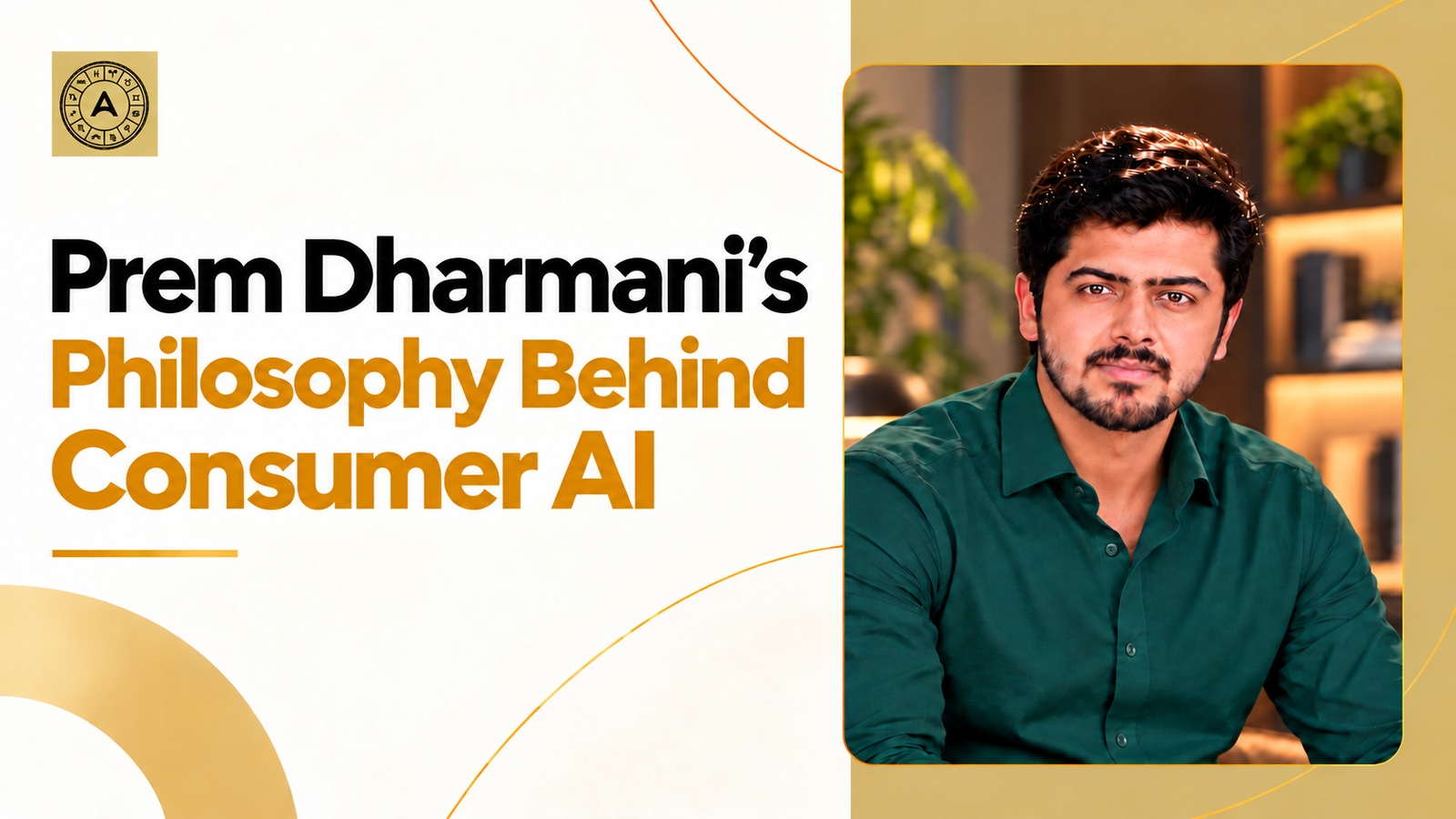
Most consumer apps are judged by one number: how long they can hold your attention. Prem Dharmani, founder of Astro247, judges his product by a different one. Did the person leave with more clarity than they came with? That question sits at the centre of Prem Dharmani product philosophy on consumer AI. It shapes how his tool answers people, how it explains itself and, just as importantly, what it refuses to do.
“Most apps are designed to keep you scrolling,” says Dharmani. “I’d rather build something that gives you what you came for and lets you get on with your day.”
A Product Leader Who Questioned the Engagement Playbook
Dharmani comes from India’s consumer technology space, where he spent years working on products used by millions of people. That experience gave him a close view of how growth metrics shape product decisions. Often, they shape them in ways users never see. “I’ve sat in rooms where the only question was how to increase time spent,” he says. “Nobody asked whether the user was actually better off. That question stayed with me.”
When AI moved from enterprise tools into people’s phones, he saw a chance to answer that question differently. Consumer AI, in his view, would soon be handling some of the most personal questions people have. That raised the stakes on getting the design right from the start.
Principle One: Show the Reasoning, Not Just the Result
The first pillar of Prem Dharmani’s thinking is explainability. An AI that hands down verdicts without context asks people for blind trust. He believes users deserve more than that.
“If an AI tells you something about your life, you deserve to know why,” he says. “An answer you can’t question isn’t guidance; it’s an instruction.” At Astro247, this shows up in how insights are delivered. The chat format lets users read the reasoning behind each response, come back to it later, and ask follow-up questions at their own pace. The company calls this “depth without dependency.”
Principle Two: Consistency Is a Form of Respect
Ask two human advisers the same question and you may get two different answers. Mood, experience, time pressure, and personal bias all play a part. Dharmani sees consistency as one of the quiet advantages AI can offer if it is built with care.
“People don’t need a different answer every time they ask,” he says. “They need one they can trust. Consistency is how you show users you take them seriously.”
Astro247 says every user receives insights based on the same verified logic. It is applied the same way whether someone opens the app at noon or at 2 a.m.
Principle Three: Never Build Growth on Fear
This is where Prem Dharmani’s thinking breaks most sharply from his category. Personal guidance services have long faced criticism for using anxiety to sell. A worrying prediction creates urgency, and urgency drives the next paid consultation. Dharmani calls it a trade he isn’t willing to make.
“Fear converts well in the short term. It also destroys trust for good,” he says. “We made a decision early on that we would never build our growth on someone’s anxiety.”
In practice, the product frames its insights around patterns and possibilities rather than doom. The company states that it avoids fear-driven narratives and dependency-based engagement models. For a consumer product, that means deliberately giving up one of the easiest levers available.
Principle Four: Measure Success by Confidence, Not Dependency
Most subscription products want users to need them more over time. Dharmani’s fourth principle turns that around. “A good product should leave you more confident in your own decisions, not more hooked on the app,” he says. “If people need us less over time, that’s not failure. That’s the product working.”
It is an unusual position for a founder to take in public. It also reflects a wider shift he expects across consumer AI, where trust becomes the metric that decides who remains.
Why Personal Guidance Is the Toughest Test for Consumer AI
Prem Dharmani chose a category where trust is hard to earn. People bring questions about marriage, career, and family to his AI tool, often at moments of stress or uncertainty.
“People ask an AI things they would never say out loud to another person,” he says. “That’s a responsibility, not an opportunity to upsell.”
Astro247 offers AI chat and voice consultations around the clock, with no appointments or queues. According to the company, the platform had served more than 3 million users by January 2026, with around 88% of them based in India. For Dharmani, the numbers matter less than what they suggest. People will bring sensitive questions to AI when the experience feels honest and free of judgement.
Building Lean, Building Honest
Astro247 describes itself as bootstrapped, run by a small core team, with growth driven largely by organic adoption rather than heavy ad spending. Prem Dharmani sees that constraint as part of the philosophy, not a limitation. “When you don’t buy growth, the product has to earn every user. That keeps you honest about what’s actually working,” says Dharmani.
What Comes Next for Consumer AI
Prem Dharmani believes consumer AI is moving towards agentic systems that carry context across conversations and respond with emotional awareness. The company has said it is investing in this direction, alongside plans to bring its India-built platform to more international users. He is clear about what will separate the products that last from the ones that don’t.
“The next phase of consumer AI won’t be won by the smartest model,” he says. “It’ll be won by the products people trust with the questions that matter to them.” Dharmani is building Astro247 on the bet that he’s right.