










The Changing Image of India in Western LiteratureThe Changing Image of India in Western Literature
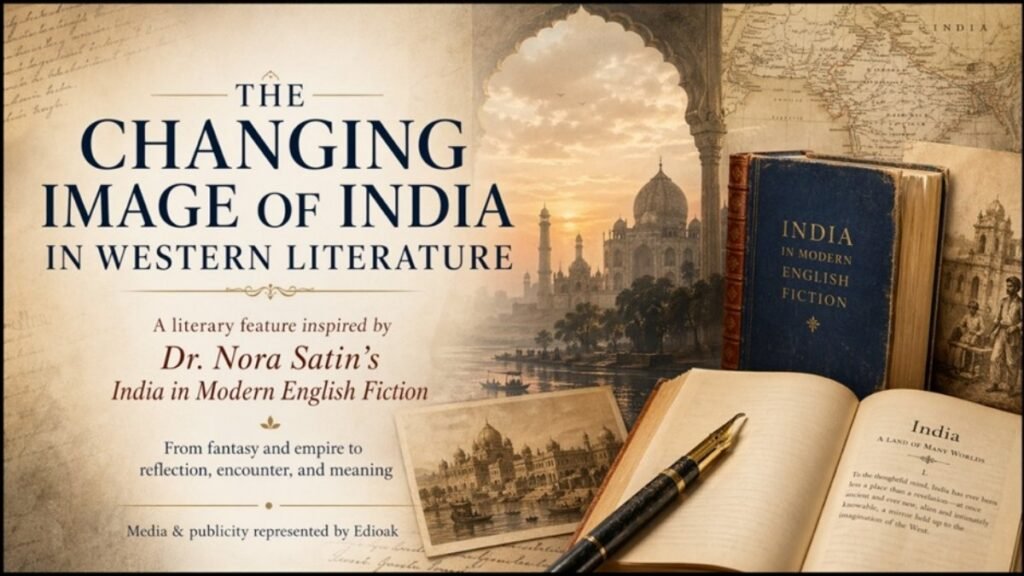
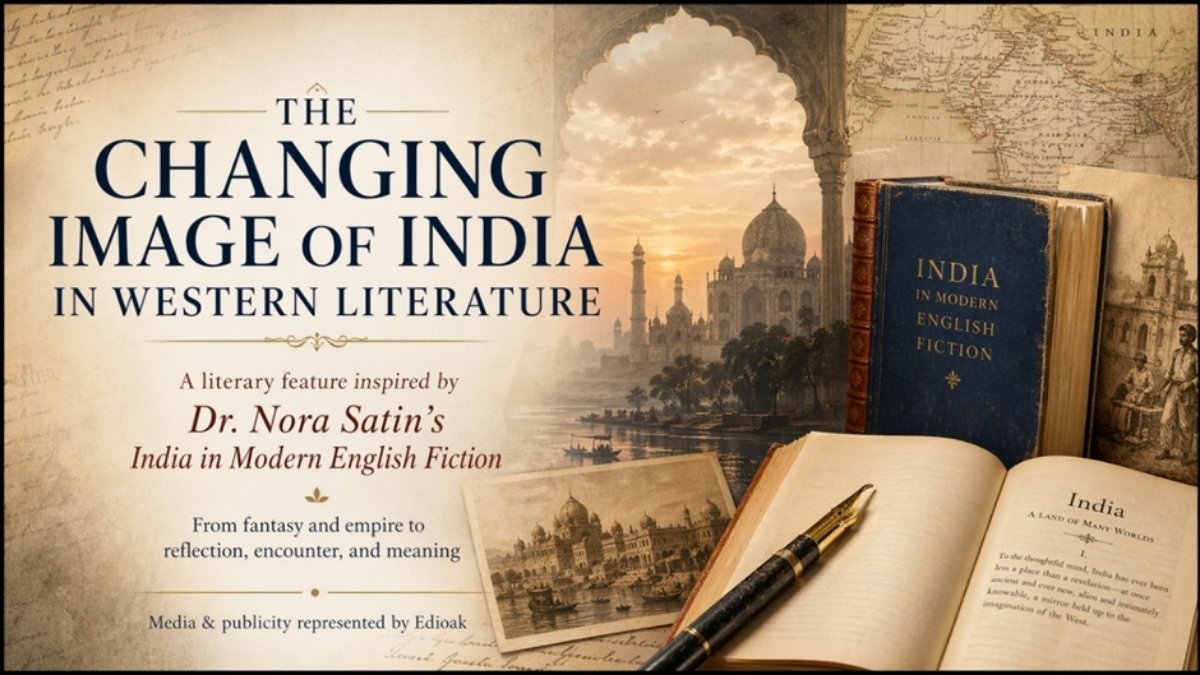
In early English writing, India often appeared as a distant idea rather than a lived reality. It was associated with wealth, strangeness, beauty, scale, religion, and wonder. Writers invoked it as a place of jewels, spice, grandeur, and mystery, sometimes with admiration, sometimes with fantasy, and often without much direct knowledge. That early image told readers as much about England as it did about India. It reflected distance, desire, projection, and the tendency to turn unfamiliar places into symbols. Dr. Nora Satin’s India in Modern English Fiction follows the long evolution of that image and shows how Western writing about India gradually moved from fantasy and possession toward something more reflective, uneasy, and, at times, genuinely searching.
India as Imagination Before India as Experience
One of the most striking things about early Western writing on India is how often India appears as an imagined landscape. It sits at the edge of maps and at the center of fantasy. In the literature of early modern England, India could function as shorthand for abundance, distance, or marvel. It was less a particular society than a symbolic elsewhere.
That pattern makes sense. For many writers and readers, India was far away and known indirectly. Reports from merchants, travelers, and diplomats mingled with rumor, commerce, and literary convention. The result was an image that was visually rich but often culturally thin. India shimmered in the mind before it arrived on the page as a place of real human complexity.
What Dr. Satin does especially well is show that this early image was not harmless decoration. It helped shape the habits through which the West later approached India more concretely. Before there was rule, there was imagination. Before there was administration, there was projection.
From Wonder to Control
As British contact with India deepened, the tone of the writing began to change. India was no longer only a place of marvel from afar. It became part of imperial experience, and that altered the language around it.
Travel writing, diplomatic records, and fiction increasingly presented India not just as a source of wonder, but as something to be described, interpreted, and eventually governed. This was the shift from fascination to control. The more Britain involved itself in India politically and economically, the more literary representation absorbed the logic of classification and possession.
Yet even in those earlier accounts, the limits of understanding are visible. India might be described in great detail, but description is not the same as comprehension. Much Western writing remained more comfortable with spectacle than with inward understanding. It could see wealth, courts, rituals, and landscapes. It had much more trouble seeing India on its own terms.
That tension matters because it runs through the entire literary history that follows. Western literature did not simply “discover” India and then describe it better over time. It repeatedly struggled with the gap between seeing and understanding.
Kipling and the Complexity of Nearness
Rudyard Kipling marks an important turning point because he wrote about India with immediacy rather than from pure distance. He knew its atmosphere, its routines, its pressures, its codes, and its contradictions. His work has a texture that earlier romantic depictions often lacked.
But closeness did not produce simplicity. Kipling’s India is vivid and energetic, yet also tense. He writes from inside empire, but his work often reveals the strain inside imperial confidence. Colonial life in his fiction is not only powerful. It is also narrow, exhausting, and morally unstable. His Anglo-Indian world can feel at once authoritative and deeply vulnerable.
That is one reason Kipling remains difficult to categorize. He is undeniably shaped by empire, yet he is also alert to the fact that India exceeds the system trying to contain it. In Kim, for example, political routes, espionage, and imperial movement exist alongside spiritual searching, layered identity, and questions of belonging. The result is not a settled vision of India, but a world in which the imperial imagination encounters something it cannot fully master.
Dr. Satin’s framing helps clarify this. Kipling’s importance lies not just in the fact that he wrote from within colonial India, but in the fact that his writing often exposes the fragility of the worldview it seems to defend.
Forster and the Problem of Human Connection
With E.M. Forster, the literary image of India changes again. The focus moves away from the daily mechanisms of empire and toward the deeper question of whether real understanding is possible across the divides empire creates.
A Passage to India remains central because it does not pretend this question can be solved easily. It asks whether friendship, trust, and mutual recognition can survive under political inequality, racial hierarchy, and historical suspicion. Forster does not answer with certainty. Instead, he allows the difficulty to remain.
That is part of what makes his India so powerful. It is not a puzzle waiting for a clever British mind to decode it. Nor is it simply a backdrop for imperial drama. It is a place where Western liberal confidence begins to falter. Good intentions are not enough. Human feeling is not enough. The structures surrounding people shape what they can and cannot become to one another.
Dr. Nora Satin is right to treat Forster as a crucial bridge figure. He represents a Western imagination beginning to understand that India cannot be possessed intellectually any more than it can be possessed morally. It has to be encountered with a greater degree of humility, and even then, full understanding may remain out of reach.
Huxley and the Inward Turn
Aldous Huxley represents a later and quite different stage in the story. If earlier Western writers had approached India through wealth, empire, or moral encounter, Huxley increasingly approached it through philosophy and the inner life.
What makes his trajectory interesting is that it was not immediate. Like many Western intellectuals of his period, he moved over time from skepticism toward a more serious engagement with Indian spiritual thought. That shift reflected something larger than personal preference. It reflected a crisis within modern Western civilization itself.
As Europe experienced war, disillusionment, and the visible limits of material progress, India began to appear to some writers not as a problem to be solved, but as a source of insight. The attraction was not to spectacle, but to forms of thought centered on consciousness, balance, inward discipline, and the search for meaning beyond power.
Dr. Satin’s account points to this movement clearly. By the time one reaches Huxley, India is no longer simply an object in Western literature. It is becoming a challenge to Western assumptions about progress, knowledge, and human fulfillment.
More Than a Literary Shift
What emerges across these writers is more than a change in literary style. It is a change in the Western mind.
India begins as fantasy, then becomes imperial subject, then moral pressure, and finally philosophical resource. That is not a clean or linear story, and older habits of simplification never disappear entirely. But there is still a recognizable movement. Western writing about India becomes less confident in its own authority and, at its best, more aware of its own limitations.
That may be one of the central insights of India in Modern English Fiction. India’s changing image in Western literature is not only about India. It is also about what the West gradually learns about itself when its certainty begins to weaken. Literature becomes the place where that weakening can be observed most clearly.
Why This Still Matters
This history still matters because the impulse to flatten other cultures has not gone away. It has only changed its vocabulary.
Even now, societies are often reduced to shorthand impressions, visual stereotypes, and borrowed narratives. The speed of modern media can reproduce many of the same habits that shaped earlier literary distortions. We think we know a place because we recognize its imagery. We mistake familiarity for understanding.
That is why a study like Dr. Nora Satin’s feels timely. It reminds us that serious reading can complicate easy perception. It shows how a culture first imagined from afar may gradually force its observers into deeper forms of reflection. And it suggests that literature, at its best, does not merely preserve impressions. It tests them.
India’s place in Western literature remains important not because the West finally “got it right,” but because the ongoing effort to write India revealed so much about the changing limits of Western thought itself.
From Mystery to Meaning
If there is a broad arc here, it is not simply from ignorance to knowledge. It is from projection to self-questioning.
India first appeared in Western literature as a place onto which fantasies could be cast. Over time, it became something more demanding: a place that challenged inherited frameworks, disturbed easy superiority, and raised questions that could not be answered through empire alone.
That is what gives this subject its staying power. India has remained powerful in Western literature not because it can be reduced to one role, but because it keeps refusing reduction. It has been written as wealth, distance, contradiction, wisdom, burden, beauty, and philosophical counterpoint. None of those is enough. Together, they show a long and unfinished history of encounter.
And that unfinished quality may be the most honest part of all.
Media and publicity:India in Modern English Fiction is being represented by Edioak for literary outreach, interview coordination, review copy support, podcast pitching, and feature placement.